torek, 06. oktober 2026 leto 31 / št. 279

Ekonomska gibanja sveta po novih podatkih (2): Postavljanje novih razmerij moči
 Priprave na krizo - prepozne?
Objavljamo drugi del serije člankov o ekonomskih gibanjih sveta.
Bruto domači proizvod (BDP) posameznega leta je skupek vrednosti, ki jih posamezna družba ustvari v določenem letnem obdobju.
Ali npr. odpiranje vrat hotela s strani portirja, podajanje vlažnih krpic strankam, deljenje letakov, sklenitev zavarovalne police s strani zavarovalničarja, podelitev posojila s strani bančnika, všečki in reklame spletnih vplivnežev prispevajo k večjemu BDP-ju?
Nekdaj je bila to pretežno vrednost kmetijske dejavnosti, z nastop industrijske revolucije še vrednost industrijskih in obrtnih proizvodov, storitvenih dejavnosti, sedaj tudi vrednosti finančnih storitev in še kaj.
Vendar pa se človek vpraša, ali npr. odpiranje vrat hotela s strani portirja, podajanje vlažnih krpic strankam, deljenje letakov, sklenitev zavarovalne police s strani zavarovalničarja, podelitev posojila s strani bančnika, všečki in reklame spletnih vplivnežev prispevajo k večjemu BDP, ali pa je to družbeno nepriznano delo, ki ne prispeva k višjemu BDP?

Številne industrijske države so v zadnjem stoletju šle skozi proces, ko so iz proizvodne družbe prešle na storitve in iz storitvene družbe prešle v digitalno družbo. Pa se zdi, da ne gre tako enostavno. Preprosto ne gre, da bi samo nekatere države proizvajale izdelke, druge pa naj bi proizvajale digitalne storitve, živele od finančnih, zavarovalniških poslov, preprodaje nepremičnin in trgovanja na borzi.
Proces deindustrializacije ima tako veliko ceno. Pa si poglejmo, kako je prišlo do tega in kdo ima od tega največ koristi.
V letu 1996 so bili glavni svetovni proizvajalci, ki so proizvedli 19 % svetovnega BDP
Združene države Amerike 23 %
Japonska 21 %
Kitajska 5 %
Nemčija 10 %
Velika Britanija 4 %
Francija 3,5 %
V letu 2026 bodo razmerja postavljena na glavo. Vrednost proizvodov po tekočih cenah je znašala cca 48.000 milijard ameriških dolarjev in znaša 15 % svetovnega BDP
Združene države Amerike 16 %
Kitajska 30 %
Nemčija 5 %
Japonska 4,7 %
Indija 3 %
Rusija 2 %
Razlogi za takšno spremembo so jasne. V želji po optimalnem dobičku so konec 20. stoletja zahodne korporacije prenesle proizvodnjo na neskončni kitajski trg.
Niso pa računale na to, da bo Kitajska prevzela njihovo tehnologijo, jo osvojila in nadgradila in postala tovarna sveta. Izgubljene proizvodne zmogljivosti je v današnjem svetu nemogoče dobiti nazaj: izginejo dobavitelji, logistične poti, izkušena delovna sila, tehnologija, trg, znanje in razvoj.
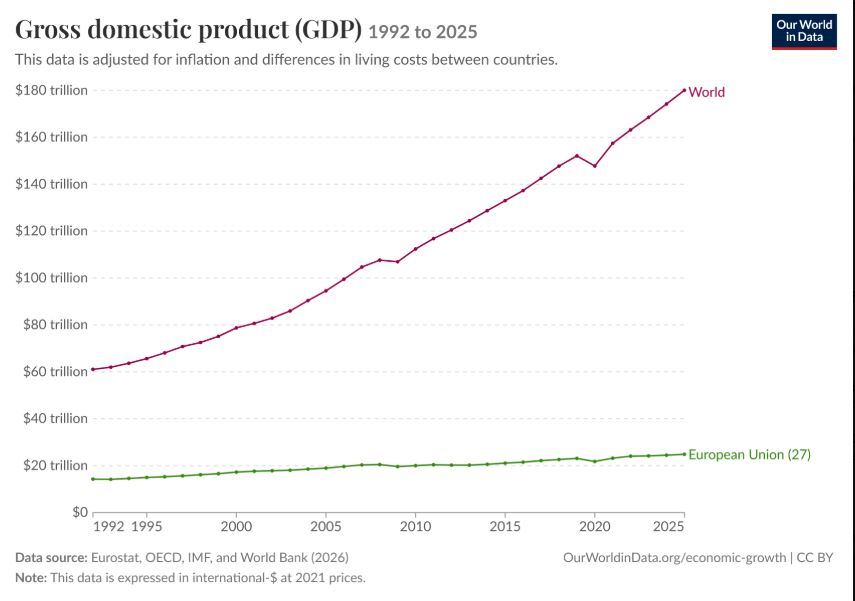
Bruto domači proizvod (BDP) posameznega leta je skupek vrednosti, ki jih posamezna družba ustvari v določenem letnem obdobju. Vendar je zelo slab kazalec. Številni drugi pa kažejo, da se gospodarska razmerja moči v svetu hitro spreminjajo.
Pa si poglejmo kako so šle stvari narobe po nekaterih izpostavljenih gospodarskih panogah in posameznih državah.
Ladjedelništvo je ena izmed klasičnih industrijskih gospodarskih panog. ZDA so leta 1950 proizvedle še 10 % vse svetovne tonaže. Do leta 1996 je ta odstotek padel na 1,8 %., danes je ta odstotek padel nekje na 0,03 do 0,2 % in preostale od ameriških ladjedelnic proizvajajo predvsem vojaške ladje ameriške mornarice, ker se nekako ne spodobi, da bi se vojaške ladje države proizvajale nekje v tujini.
Na drugi strani je kitajsko ladjedelništvo v letu 1950 dosegalo morda 1 % svetovne tonaže, ta odstotek je do leta 1996 narastel glede na različne vire na 5,5 do 8,4 %.
Brilliant Substack piece by CAMERON MCGREGOR @ceamac https://t.co/WqNf7X8wgh China Preps for the Monetary Mushroom Cloud. China is hoarding gold as a fallout shelter for the incoming monetary blast. Cameron Macgregor Jul 27, 2026 @ceamac A monetary mushroom cloud is gusting and China is battening down the hatches. A monetary regime change unseen in 100 years is unfolding before our eyes. In June, China officially banned retail trading of paper gold (AKA leveraged gold trading). First, IDCBF, then Postal Savings Bank, Ping An Bank and China Guangfa Bank followed suit. Why? For the last 20 months, the People’s Bank of China (PBOC) has accumulated +2.3K tons of gold (probably more). PBOC and Central Banks et al have been price-insensitive buyers, continuing to buy through gold’s recent -25% correction. Quietly, China has been hoarding gold since the Shanghai Gold Exchange (SGE) launched in 2002, followed by SGE International (SGEI) in 2014. When combined with Hong Kong’s vastly expanding vault storage, China has discreetly overtaken the London Bullion Market Association (LBMA) in the UK + Chicago Mercantile Exchange (CME) in the US as the price setter for spot gold. So what and who cares? Since 1971, Wall Street has essentially set the price of global commodities via cheap energy and cheap credit. Cheap energy came from controlling the global energy complex via naval command of strategic sea lanes and anchoring OPEC’s defense shield. Cheap credit came from maintaining low rates via suppressing the price of gold through futures markets and dollarizing global assets. Both pillars are caving in. Losing control of the Straits of Hormuz (SOH) means control of the global energy complex is gone and China’s surging share of physical stock means gold will reset. When paper trading gives way to spot prices gold will skyrocket and interest rates (cost-of-capital) will soar along with it. Unfortunately, these actions are gravely misinterpreted in the West. Wall Street analysts, DC policymakers, and X conspiracy theorists continue to frame the monetary world as a battle between the Renminbi and USD. That is not the case. Contrary to consensus, China’s actions are less a blitzkrieg in the “battle over real money” and more a Great Monetary Wall, a fallout shelter for the dollar wreckage to come. Beijing hit a monetary fire alarm so silent it is deafening because the dollar-debt-based system is melting down. What system (not what currency) replaces it is the question? How is the Dollar-System melting down? In a world priced in dollars, capital (plant and equipment) and commodities (energy, rare earths, precious metals) may be domiciled outside the West but carried as assets on Western ledgers. The dollar system functions so long as there is network discipline, so long as global assets and transactions remain dollarized; if they revalue on a non-dollar-ledger, “Houston we have a problem.” Since 2022, Western praetorians (Swift, IMF, World Bank, USM) who enforce network discipline are losing power. First, seizing Russian sovereign assets, slapping sanctions, and proxy war were supposed to break Russia and set an example. Instead, Putin’s pre-war defensive measures to offload Treasuries in favor of gold followed by pegging Rubles to energy exports weathered the storm. However, the real earthquake was the Global South’s refusal to enforce Western sanctions and Russia’s battlefield victories. Essentially, the SMO was a successful proof-of-concept that exiting the dollar network was possible. Why is this such a problem for Western bankers? If there is a ledger switch - ditching the dollar system for a gold-backed-one - the legacy system implodes. A premeditated revaluation of dollar-denominated assets in gold (and non-dollar-currencies) will prompt a massive deflationary collapse. Prices set in dollars are artificially propped up by low rates (cheap credit) and Wall Street bubbles not real returns, and gold reveals the disparity. (see below) The Feasury (Fed + Treasury) will resist any dollar-gold revaluation with all its monetary might for this reason. What is at stake here is nothing less than what investor Chris MacIntosh called the “Clash of the Systems,” a conflict between industrial and financial capitalism, or you might say between synthetic and real-economy. The Global South led by BRICS and the financialized West are poised for a split that will fracture the monetary system permanently. Split how? Way back in 2022 MacIntosh envisioned the following scenario: “So now how do you go about developing a currency system? Anyone participating in the BRICs/G8 new system will not be penalized for any defaults to Western/NATO/EU/UN/WEF conspirators. That alleviates the risk of sanctions from members of the BRICs/G8. Which is significant. Next up; the BRICs will champion the nationalization of assets. We spoke about resource nationalism waaay back in mid 2018. This will allow the Global South to collateralize the currency system.” Chris MacIntosh - “Clash of the Systems” Persian fire in the Gulf has hastened the financial endgame. War for Jewish supremacy against Iran has inverted global power. In a demo of Iran’s 21st century platforms against America’s 20th century fleet the result has exposed the limits of US Military (USM) power, a disaster for the dollar and the bankers who arbitrage it. With emaciated industrial capacity and the military power it enables, America’s ability to enforce network discipline is materially damaged. Translation: deindustrialization via financialization orchestrated by the Epstein class has defanged the dollar’s military praetorians. Wall Street and DC have yet to figure this out. Essentially, the US no longer holds the monetary whip hand. It is only a matter of time before USD denominated assets in the Global South sitting on Western bank balance sheets are placed on a new ledger. That is to say, nationalized or repossessed by host nations and denominated in a new currency, as MacIntosh suggested. “The current predicament for a lot of EM countries is that they are indebted in a currency that they don’t control, having pawned their assets (mineral leases, refineries, mines etc.) to Western private companies. These western companies (Haliburton for e.g.) pay enormous sums of money via lobby groups in order to own the politicians who direct the “initiatives” via the likes of the IMF and the World Bank. Those entities then indebt the countries ensuring they remain a slave class. There is no incentive whatsover to stop this. Why would they?” Chris MacIntosh - “Clash of the Systems” Certainly a ledger switch sounds very hypothetical. How and why would Argentina, Indonesia, or Nigeria et al cancel dollar-based-contracts, revalue national currencies, and default on IMF loans? The why should be obvious, though the bankers find it inscrutable. The reasons are worth enumerating: Dollar Weaponization - assassinations, coups, sanctions, seizures, tariffs etc. have made using the dollar incompatible with sovereignty, especially in developing countries which have become economic organ donors for the West Global Energy Disruption - Since 2022, the non-western world has concluded America is a rogue state, not a global protectorate. In their view, Western war against Russia and Iran have deliberately undermined global supply chains, food and energy security Gold Repatriation - Since 2002 the base-layer of the financial system, which remains gold, has been massively repatriated from Western vaults (New York and City of London) to the Global South, destined primarily for China Debt Doom Loop - Dedollarization is not a trend, it is the escape route from the monetary mushroom cloud. Western financial collapse, not World War Three, is the dollar’s endgame How a ledger switch occurs has been elusive, until now. As recently as last year, many asserted (and continue to do so) with conviction that the USM is the final boss for dedollarization. Iran’s decisive victory in the Gulf proves that boss has been neutralized. Alternatively, many argue the dollar wins by default since it is the “cleanest dirty shirt.” Gold’s outperformance of treasuries says otherwise, but is merely stocking physical gold enough? The Silk Road is Paved in Gold Switching ledgers still requires a viable parallel system (not an alternative world reserve currency) and China has built one. It is a global trading network shored up by robust energy and industrial resources and transacted in regional currencies backed by gold. Remember, China is the world’s number one trading partner, the world’s leading industrial superpower by far, and its rising diplomatic leader as well. “The Chinese do have a comprehensive long-term strategy for managing the challenge [the] United States is posing. By contrast, the leaders of the United States, both Democrats and Republicans, have not worked out an equally comprehensive long-term strategy for managing the return of China as a great power.” Kishore Mahbubani China’s isolationism has been its advantage until now. Despite fear mongering via Sinophobia inside Western elite circles, the Chinese ethnostate is almost myopically focused on domestic peace and economic prosperity. President Xi validates the Mandate of Heaven so long as he can sustain the greatest 40 year stretch of growth, modernization and prosperity in Chinese history. Xi, like the Chinese emperors before him, knows how precarious stability in China can be. As a result, China’s initiatives have been measured and strategic: Belt and Road Initiative (BRI) to build-out China’s trade and energy supply chains Industrial Strategy via reinvestment away from real-estate and towards “Heavy Asset Low Obsolescence” (HALO) Energy Dominance through long-term energy storage and grid diversification Strategic Partnerships through diplomatic, military and trade vehicles like BRI, BRICS and the Shanghai Cooperation Organization (SCO) “China is the only major economy with no meaningful inflation problem, and thus no genuine constraint on government policy. China is also one of the few major economies to have followed a rational, and consistent, energy policy over the past decade.” Louis-Vincent Gave - Shattered Assumptions and the Energy Quandary China’s gold complex is an insurance policy. The Chinese have zero interest in destroying the green back, nor will they open mainland capital markets to international capital, lest they become financialized like the West. Rather, China’s gold provides a protective moat to insulate them from the monetary mushroom cloud and offers a backup system when the time comes for the ledger switch. Is now the time? End-of-Cycle Financial Flood Any software engineer knows that running systems in parallel is unsustainable so who or what will throw the final switch? As disastrous as wars in Ukraine and the Middle East have been for the global economy, as foolish as it was to confiscate Russian sovereign assets, and as rogue as the US has become under the influence of Jewish power, the final straw remains the tempest of financial markets. As disastrous as forever wars have been the final straw remains the tempest of financial markets. Stress is rising at the core of the system and Western citadels of power do not care. Since 2020, inflation (cost-of-living) and interest rates (cost-of-capital) are structurally higher mainly because of massive money printing and surging borrowing costs. Fed trickery via quantitive easing, tightening or rate hikes has been unable to arrest these shifts. If fiscal meltdown in Japan is any guide (Japan set the monetary doomsday machine in motion 30+ years ago) Fed actions going forward will either fall flat or boomerang. Markets move in fractals. The best traders look beyond 200-day moving averages to factor in long-term-cycles. 2020’s Covid Pandemic nearly bookended a century since the Great Influenza in 1918. The S&P 500 fast approaches the 100th anniversary of October’s Black Thursday 1929, a scary parallel indeed. Is Global War the Endgame? Ray Dalio reminds us that world reserve assets last about a century or so and currency wars are kinetic. The last three reserve currencies were established after major wars: the Dutch Gilder, the British Pound, and USD. However, despite protestations otherwise, human events are always one of one, each scenario is different and unprecedented. This time will likely be profoundly different because the global stage is no longer dominated by a Western Game of Thrones. “Out of these debt, economic, domestic, and world-order breakdowns that take the forms of revolutions and wars come new winners and losers. Then the winners get together to create the new domestic and world orders.” Ray Dalio - The Changing World Order The West is succumbing to internal afflictions. Western States are fiscally bankrupt, economically hollowed out, and Western populations are on edge. The dilapidated state of Western nations is a direct reflection of the ruling Epstein class. Ironically, degenerate elites are flexing Western power at its weakest point in a century not by design, by delusion. WWIII is not a likely outcome because the West lacks the capacity to wage such a war and the Global South has no interest in fighting it. American State and society in particular could not mass mobilize as was done during WWII. Deindustrialization is chronic and the systemic breakdown of governance are symptoms of incapacity but the real problem is internal division. WWII-era America was a homogenous, high-trust, monoculture; America today is a tribal turf war whose tensions are heating up by the month. A darker risk of a nuclear strike is a more problematic threat. However, nukes are not weapons of war, they are weapons of eschatology, and Israel is the ONLY nuclear power possessed by such apocalyptic visions. Guard rails against Israeli first-use are also tenuous because Jewish power has a firm grip on the US government. So what stops Israel from resorting to the Sampson option? Since October 2023, Israel has launched a genocide in Gaza, waged war against Arab neighbors for Greater Israel, and plunged the Middle East into a regional war with Iran. As a result, the Zionist State has become a global pariah and poisoned the well with the American ethnos as well. The United States is the last ally standing but it is only a matter of time and collateral damage before Americans cuts ties with Israel; the parasitic relationship is too costly to bear. A New Ledger, a New System, a New Order A new system based on a new ledger is the endgame. The fact of the matter is that the post-WWII world order and its iterations since have reached entropy. The Multipolar Monetary World Order (MMWO) is coming into view and the Chinese see it more clearly than most. Its characteristics are discernible for those paying attention: Gold will reemerge to anchor a new multi-nodal system Renminbi will not be swapped out for USD Major powers will determine reserve status by region America will adopt a new currency (Bitcoin will play a role) The eurozone will collapse, retrenching Europe along historic fault lines The destination may be clear but the journey will be stormy. Questions abound: How devastating will the financial unwind of the dollar-system be for the world and the West? How will Western frontier wars in Ukraine and the Middle East ultimately resolve themselves? Will there be a nuclear exchange initiated by a flailing Zionist State? Can a new order (succession) emerge in the West sooner rather than later to smoothen out the transition? These questions and many more can only be answered in time. What should be clear is that the global order desperately needs a reset. It is important to reframe the transition outlined above as both necessary and beneficial to the world, especially to the West. Western economies desperately need financial-economic retrenchment and a dollar-default is the only way to get there. Further, we need a new multipolar rule set that permanently ends Western universalism both abroad and domestically. Whatever comes next is likely to be an improvement because the world is better positioned today for global economic and political cooperation than ever before. A more even distribution of global power is a safeguard against the megalomania of universalism. The post-1990’s unipolar moment premised on the End of History was an illusion of simplicity. The world is a very complex and complexifying place whose governance systems require constant change, revision, and upgrade. What the West needs more than anything is to regain its unique sense of imagination and vision, to look beyond the obsolescent governing systems designed a long time ago for a far different world. A good first step would be to lean into the MMWO before the monetary mushroom cloud lights up the sky
— STANISLAV KRAPIVNIk (@STANISKRAPIVNIK) July 28, 2026
V letu 2026 je ta odstotek zrasel na 63 %, v letošnjem letu pa so kitajske ladjedelnice pridobile 85 % vseh svetovnih naročil po tonaži.
Nemčija je v povojnem obdobju nedvomno bila ena izmed gospodarskih velesil sveta. Njena gospodarska moč je temeljila na treh temeljih. Poceni energija v obliki zemeljskega plina in nafte, ki je v obliki plinovodov in naftovodov prihajala s področja nekdanje Sovjetske zveze.
Visoka konkurenčnost nemških proizvodov na ameriškem trgu, ki je bil orjaški in dostopen trg, brez resnih administrativnih ovir. Tretji steber je bilo povpraševanje na kitajskem trgu. Nemški proizvodi so bili ne le konkurenčni, ampak bistveno boljši od vsega kar je kitajska industrija zmogla proizvesti pred tremi desetletji.
Kakih 50 jedrskih elektrarn gradijo na Kitajskem, 10 v Rusiji, ki pomeni vrh tehnološkega znanja, preostale države jih grade vsaka le za vzorec.
Vsi ti stebri ekonomske moči Nemčije so začeli pokati in se rušiti v naslednjih desetletjih. Brezglava zunanja politika do Rusije je bolj ko ne prekinila poceni dobavo energije. Zeleni prehod se je izkazal za neskončno drago zadevo. Na leto stane med 113 in 136 milijard Eur in naj bi do leta 2045 stal med 4.800 in 5.400 milijard evrov.
Rezultat so visoke cene energije, tako tiste iz uvoza, kot lastne zelene energije.
Visoki vhodni stroški energije so povzročili, da je industrija pokleknila. Ameriški predsednik, ki predstavlja konec koncev establishment države sledi ideji »America first«, če je treba tudi na račun zaveznikov. Kar naenkrat so carine na ameriškem trgu tako visoke, da postane trg nedosegljiv.
Daleč drugje na Daljnem vzhodu se zgodi še nekaj bolj groznega. Nemški proizvodi v primerjavi z kitajskimi niso več konkurenčni ne po ceni in ne po kvaliteti.
Proizvodnja strojev je prav gotovo paradna nemška industrija. V letu 1996 je ta obsegala do 15 % vse svetovne proizvodnje. V letu 2026 je ta padel na 11 % svetovne proizvodnje.
Še eden izmed vrhuncev svetovne proizvodnje so nuklearne elektrarne. Gre za ene najbolj kompleksnih naprav, ki jih človek poznaLe nekaj držav je obvladalo tovrstno tehnologijo.
Really? Number of NEW Nuclear Energy Reactors Under Construction by Country https://t.co/g4du1zKkfR
— Oliver Groß (@minenergybiz) October 4, 2026
V letu 1996 je na svetu obratovalo približno 440 tovrstnih elektrarn. ZDA, Japonska, Rusija, Nemčija, Francija so bile države, ki so v največji meri obvladale tovrstno tehnologijo po tem vrstnem redu. Pa se je izgradnja novih naprav zaradi bridkih izkušenj s Černobilom in kasneje še Fukošimo praktično zaustavila.
Trideset let kasneje se je na bridke izkušnje že nekoliko pozabilo.
Povpraševanje po električni energiji skokovito raste in nove enote se pospešeno gradijo. Glede na to, da so v predhodnih desetletjih zaustavili številne in da je proizvodnja zastala, jih je še vedno kakih 440. Vendar jih je približno 70 v gradnji. In tu se skriva zanimiva podrobnost.
Kakih 50 jih grade na Kitajskem, 10 v Rusiji, ki pomeni vrh tehnološkega znanja, preostale države jih grade vsaka le za vzorec. Kaj se v resnici dogaja, pokaže primer Francije. Ta ima v državi 56 delujočih reaktorjev, ki proizvajajo pretežni del vse električne energije in jih je zgradila sama.
Vendar pa so bili vsi ti reaktorji zgrajeni v 70. in 80. letih in se sedaj bližajo svojemu koncu življenjske dobe. Edina nova nuklearna elektrarna v Franciji je tista v Flamanvillu. Izraža vse težave zahodne jedrske industrije.
France is where the developed-world debt problem is cracking first. Its 10-year yield has climbed to 4.7%, the highest since 2008, and the gap over German bonds just blew out to the widest since the eurozone debt crisis. The setup is textbook. Government debt is 119% of GDP, the most since 1978, the deficit is running over 5%, and a paralyzed political system cannot pass the 54 billion euros of cuts needed to slow it. So France has to sell a record pile of new debt next year while refinancing cheap pandemic-era bonds at much higher rates. Interest costs compound from here. This is the bond market doing the job politicians will not. France is just the first to crack. Every government that borrowed freely into a world of higher rates is on the same road, the US included. The era of free money is over, and the bond market is sending the bill.
— Kurt S. Altrichter, CRPS (@kurtsaltrichter) October 2, 2026
Z njeno gradnjo so začeli leta 2007 in naj bi stala 3,3 milijarde Eur z rokom izdelave 54 mesecev.
Izguba znanja, tehnologije, dobavnih verig, odhod in upokojitev jedrskih strokovnjakov je povzročilo, da je bila izgrajena šele letos poleti po 19 letih, cena pa je zrasla na 19,1 milijarde Eur.
Tovrstne razmere v realnosti vodijo v trgovinske primanjkljaje in nato v primanjkljaje plačilne bilance. V realnosti se v primerih, ko država začne izgubljati komparativne prednosti, pokaže izrazita rast na strani odhodkov in stagnacija, ali pa upad prihodkov državnega proračuna.
Prihaja do gibanj v dveh smereh. Na eni strani se opuščajo infrastrukturni projekti in ta zastareva in propada, po drugi strani pa se država zadolžuje, saj v času suhih krav želi še naprej peljati projekte, ki naj bi dodano vrednost pokazali v prihodnosti.
Pa si poglejmo primanjkljaje v plačilnih bilancah posameznih držav in posledično zadolženost:

Slika 2: Zadolženost kot oblika sodobne odvisnosti
V letu 1996 je bil nacionalni dolg ZDA 5.180 milijard dolarjev po tekočih cenah in je znašal 64,9 % BDP. Letni primanjkljaj plačilne bilance je bil 107,4 milijard dolarjev. To so bili še časi, ko je propadel komunizem in je Kitajska začela s svojim vzponom. Čas ko je bila država nesporno številka 1.
V avgustu 2026 je nacionalni dolg ZDA dosegel 40.000 milijard dolarjev po tekočih cenah in je znašal 131 % BDP. Letni primanjkljaj plačilne bilance bo presegel 2.100 milijard dolarjev kar naj bi znašalo cca 6 % BDP.

Slika 3: Nacionalni dolg ZDA, 2006–2026

Slika 4: Zvezni dolg ZDA v rokah javnosti, 1900–2053, v % BDP
Japonski nacionalni dolg je v letu 1996 znašal 4.281 milijard dolarjev oziroma 85 % BDP po tekočih cenah. Letni primanjkljaj je znašal 4,75 % BDP oziroma 230 milijard dolarjev.
V letu 2026 nacionalni dolg znaša 8.500 milijard dolarjev oziroma med 204 in 249 % BDP.
Most people don’t yet grasp what is happening in France. Markets are pricing French sovereign debt as junk, rating agencies will eventually have to follow. This will have two major impacts: 1. Most French banks are already rated at or just below the sovereign, so a move toward junk would likely drag domestically focused lenders with it. Credit to households and firms would slow sharply, hurting the economy and widening the fiscal deficit even further, a vicious cycle. 2. For the ECB, the constraint is legal as well as financial. A fall below investment grade would force sales by ratings-bound investors while making any backstop harder to justify under current rules. The next euro crisis will begin in France. The first, which began in Greece, will feel like a walk in the park compared with what comes next.
— Michael A. Arouet (@MichaelAArouet) October 2, 2026
Letni primanjkljaj pa je znašal 47 milijard dolarjev oziroma približno 1 % BDP
V letu 1996 je nemški nacionalni dolg znašal 1.118 milijard Eur, kar je znašalo 57,7 % BDP.
Deficit tega leta je znašal 72 milijard Eur.
V letu 2026 bo nemški nacionalni dolg presegel 3.000 milijard Eur, kar bo znašalo 63,5 % BDP.
Predvideva se, da bo primanjkljaj tega leta znašal okoli 150 milijard Eur.
Če gre pri Nemčiji za še nekako obvladljiv dolg so gibanja v Veliki Britaniji veliko bolj zaskrbljujoča. V letu 1996 je nacionalni dolg znašal 323 milijard funtov, kar je znašalo 45 % tedanjega BDP po tekočih cenah. Primanjkljaj tega leta je znašal 27,1 milijarde funtov oziroma 3,4 % BDP.
Trideset let kasneje je položaj javnih financ Velike Britanije naslednji.
Nacionalni dolg znaša 2.985 milijard funtov, kar je 94,1 % BDP. Primanjkljaj tega leta bo znašal predvidoma 116 milijard funtov oziroma 3,6 % BDP.
Nekaj podobnega se dogaja v Franciji. Javni dolg Francije v letu 1996 je znašal 755 milijard Eur, oziroma 60,6 % BDP, primanjkljaj je znašal 356 milijard frankov oziroma 3,9 % BDP
University graduates start their career with unmanagable debt in the USA. In China, they graduate free of burdens and ready to immediately add value to their country. https://t.co/QaDkHh4ODB
— Jason Smith - (@ShangguanJiewen) September 29, 2026
Trideset let kasneje je javni dolg Francije v letu 2026 znašal 3.500 milijard Eur, oziroma 118,5 % BDP.
Samo v letu 2026 naj bi deficit znašal okoli 230 milijard Eur oziroma 5,4 % BDP
Pa si v nadaljevanju poglejmo, kakšno je stanje pri konkurenci.
Rusija je v letu 1996 imela javni dolg okoli 136 milijard dolarjev kar je znašalo okoli 45 % BDP. Deficit tega leta je znašal nekje med 4 in 5 %
V letu 2026 bo ruski javni dolg znašal okoli 439 milijard dolarjev, kar bo znašalo okoli 17 do 18 % BDP.
Po petih letih vojne je v letu 2025 deficit znašal 72 milijard dolarjev oziroma 2,6 % BDP
Kitajska je v letu 1996 imela javni dolg v znesku 184 milijard dolarjev, kar naj bi po različnih meritvah znašalo med 6,9 in 21 % BDP. Primanjkljaj tega leta je znašal 0,75 % BDP oziroma 21 milijard dolarjev.
V letu 2026 naj bi javni dolg Kitajske znašal 14.500 milijard dolarjev oziroma nekje med 88 % in 102 % BDP. Primanjkljaj tega leta naj bi znašal 4 % BDP oziroma 854 milijard dolarjev.
Tovrstni dolg je potrebno odplačati. Že dolga desetletja države ne razmišljajo več o tem kako dolgove odplačati, ampak izvajajo t.i. servisiranje dolga.
To pomeni, da vsako leto najemajo nova posojila, da odplačujejo predhodna.
Po posameznih državah je strošek servisiranja dolga dosegla neverjetne številke.
V ZDA je strošek servisiranja v letu 2025 presegel 1.000 milijard dolarjev, oziroma 3,3 % BDP. Država to običajno počne z izdajanjem obveznic. Obrestna mera 30-letne ameriške obveznice v septembru 2026 znaša 5,28 % letno in strmo narašča. Če bi bila cena servisiranja celotnega ameriškega dolga na tej obveznici, bi cena servisiranja presegla 2.000 milijard dolarjev na leto.
A record $1.45T of US corporate debt matures by 2030. Much of it was borrowed when money was nearly free. Refinancing at today's rates means profits must grow as fast as borrowing costs, or the maths breaks. Futures markets are pricing 3-4 more Fed hikes by the start of 2028. Are we about to see a credit crisis?
— Nic (@puckrin) October 6, 2026
V Nemčiji strošek servisiranja dolga znaša 28,5 milijarde Eur letno in ostaja pri 1 % BDP. Zaenkrat.
Vendar pa je strup v podrobnostih. Cena 30 letne nemške obveznice strmo narašča in v septembru 2026 znaša že 3,82 % letno. Naj spomnim celotni nemški dolg bo letos dosegel 3.000 milijard Eur.
Če v Nemčiji vse skupaj zaenkrat še deluje obvladljivo je Velika Britanija že čisto druga zgodba.
Strošek servisiranja dolga bo v letu 2026 znašal 110 milijard funtov. To pa naj bi zneslo nekje med 4,0 in 4,5 % BDP. Cena 30 letne obveznice leti v nebo in v septembru 2026 znaša 5,29 % letno.
Servisiranje japonskega javnega dolga je v letu 2026 znašalo 230 milijard dolarjev, oziroma nekje med 5 in 6 % BDP.
Cena 30-letne obveznice znaša 3 % letno.
Podobno velja za Francijo. Strošek servisiranja dolga bo v letu 2026 znašal 78 milijard Eur oziroma 2,4 % BDP. Cena 30-letne obveznice znaša 4,2 % in strmo raste.
Rusija je čisto drugačna zgodba. Strošek servisiranja dolga bo v letu 2026 znašal 48 milijard dolarjev oziroma 2 % BDP.
Država je izločena iz svetovnih finančnih trgov in tako ima 30-letna ruska obveznica ceno 16,4 %. Vendar pa je to brezpredmetno, saj se država na svetovnih finančnih trgih ne zadolžuje, ampak je ta dolg znotraj države.
Bruto domači proizvod (BDP) posameznega leta je skupek vrednosti, ki jih posamezna družba ustvari v določenem letnem obdobju. Vendar je zelo slab kazalec. Številni drugi pa kažejo, da se gospodarska razmerja moči v svetu hitro spreminjajo.
Kitajska velja na finančnih trgih za zgodbo o uspehu. Strošek servisiranja letnega dolga bo v letu 2026 znašal 352 milijard dolarjev nekje med 1 in 2 % BDP. Cena njene 30-letne obveznice znaša 1,68 %
Ekonomska moč države se pokaže tudi v njeni trgovinski bilanci.
Pred očmi avtorja se pokaže položaj Španije v 16. in 17. stoletju.
Presežek oziroma primanjkljaj v trgovinski bilanci pokaže ekonomsko konkurenčnost države in nekoliko plastično. Ali priteka zlato v državo ali iz nje odteka.
Pa poglejmo, kako se izkažejo posamične države:
Bruto domači proizvod (BDP) posameznega leta je skupek vrednosti, ki jih posamezna družba ustvari v določenem letnem obdobju. Vendar je zelo slab kazalec. Številni drugi pa kažejo, da se gospodarska razmerja moči v svetu hitro spreminjajo.
In 2008, the EU and US economies stood as equals. Today, the US economy is 50% larger than the entire EU combined. Here’s how Europe’s economic blunders pushed it toward decline: https://t.co/7N5p79KSI8
— Logan Weaver (@LogWeaver) December 19, 2024
ZDA bodo imele v letošnjem letu trgovinski primanjkljaj med 900 in 1000 milijardami dolarjev
Nemčija lahko v letošnjem letu pričakuje trgovinski presežek v višini 200 milijard Eur
Japonska lahko pričakuje trgovinski presežek v višini 17 milijard dolarjev
Velika Britanija lahko pričakuje trgovinski deficit v višini 22 milijard funtov
Francija lahko pričakuje trgovinski primanjkljaj v višini 70 milijard Eur
Rusija lahko v letošnjem letu pričakuje trgovinski presežek v višini 140 milijard dolarjev
Danes slovenski javni dolg znaša 46,3 milijarde Eur oziroma 64,8 % Vse to v državi z 2,1 milijona prebivalcev. Da ne omenimo zraven še dolg podjetij in fizičnih oseb.
Kitajska lahko v letošnjem letu pričakuje trgovinski presežek v višini 1.200-1.300 milijard dolarjev.
Statistika je neusmiljena in številke jasno prikazujejo kdo v današnjem svetu ostaja konkurenčen. Posledice pa so tudi lahko jasne. Pa se vrnimo na nekdanjo Jugoslavijo. Ta je v letu 1980, ko je gospodarska kriza izbruhnila s polno močjo približno 18,9 milijarde dolarjev zunanjega dolga, kar je znašalo 27 % BDP države v tem letu. Po tekočih cenah seveda. Omenjeni dolg bi po današnji vrednosti znašal 125 milijard dolarjev. Šlo je za državo s 23 milijoni prebivalcev.
Danes slovenski javni dolg znaša 46,3 milijarde Eur oziroma 64,8 % Vse to v državi z 2,1 milijona prebivalcev.
Da ne omenimo zraven še dolg podjetij in fizičnih oseb.
Vsi vemo v kakšnem popolnem kaosu in državljanski vojni je končala Jugoslavija le desetletje kasneje.
Pa je bila Jugoslavija le majhen problem v svetu, ki tedaj še ni bil globaliziran.
GIVE US YOUR TECHNOLOGY CHINA! Brussels is planning to force Chinese companies to transfer intellectual property to European businesses in return for EU subsidies as part of a tougher trade regime for clean technologies following the election of Donald Trump. New criteria requiring Chinese businesses to have factories in Europe and share technological knowhow will be first introduced into a tender for €1bn worth of grants to develop batteries in December, according to two senior EU officials. The pilot could be rolled out to other EU subsidy schemes.
— Lord Bebo (@MyLordBebo) November 20, 2024
V globaliziranem svetu pa rastejo bistveno drugačna nesorazmerja in se ravnovesje moči spreminja.
Ekonomski kazalci so neusmiljeni.
Morda pa preveč za 2. nadaljevanje gospodarskih trendov sveta.
Več o ekonomskih razmerjih v naslednjem prispevku.